Wednesday, January 13, 2010

Jeff Soto - The Pop-Surrealist Picasso

0

Hey Everyone, 

I initally found out about my favourite artist Jeff Soto when I noticed that two of my favourite bands Finch and Halifax had similar artwork on each of their albums - well a similar vibrant, zany, eclectic and trippy style which I thought and still think looks awesome beyond belief. Curious to know the artist behind the intensely beautiful album art I had a geez in the album booklets looking for the artist behind the work and my results yielded the same artist, a cryptic Californian named Jeff Soto. Wanting to see more, I did a random google images search which filled my computer screen with a myriad of beautiful works and I instantly became hooked on Jeff Soto's work.


Jeff Soto's style is his own, however, like all artists his art can be associated with the collective art movements that seem to go around and if you had to categorise it with a specific movement you'd say (well his wikipedia page says) that Soto's work is part of the pop-surrealist or Low-Brow art movement. A popular artmovement that originated from California that stems from street art, punk subculture and other subcultures that reject the status quo. Moreover, Pop-Surrealism is considered outsider art and part of the stuckism art movement which refuse to stem within the conforms of conceptual and socially accepted art. Pop-surrealist painters include: Takashi Murakami, Manuel Ocampo and the Clayton Brothers

Jeff Soto was and still is a street artist and notably, many of his artworks still contain that raw graffiti and street artesque quality about it. He's art is influenced by Californian hip-hop culture, punk culture and street art. Like street art which criticises and exposes the dull realities of suffering, Jeff communicates (according to his website) "profound visions and fears, nostalgia of his youth, and themes of love, lust, and hope". I couldn't agree more with that statement, however, I extend that there are strong anti-war as well as post-modernist (rather existentialist) elements in his work which appeals to me on deeper level as well. 
Moreover, I believe (and his website agrees with me) that there is a strong environmental element that permeates throughout most of his work. He mixes iconoraphy of the enviroment and of manmade objects to create a beautiful as well as poetic juxtaposition of the "conflict of humans trying to harness, or take advantage of nature" (his website again). He captures this battle between the natural and the artificial (or man vs. nature) through his signiture use of robotic/mecha like creatures which have mutated with nature to create arbitrary yet beautiful objects of profound fascination and an edgy melancholy.

Now for the good part. Here are some of my personal favourites ; try to guess what Jeff Soto is trying to say in all of them....


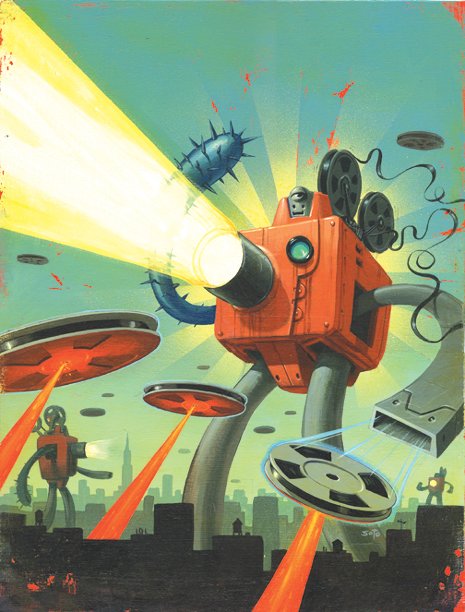
So what do you guys think? Beautiful eh? I really don't think about them too much.... I think their just visually appetizing but when I do think about them - their meaning if profound.

If you guys wanna check out his blog click here . It's a pretty interesting and awesome blog with pictures as well as explanations for the artwork he is currently working on. Amazing work. Truly amazing. 
Well, that's all I have you folks today. 
Peace out. Make Art Not War.

Tuesday, January 12, 2010

Official vs. Unofficial Vandalism

0

So, first thing’s first: I should probably define official and unofficial vandalism before I start my little rant.
Unofficial vandalism is what you normally see on the streets. Murals, pictures and tagging, and they usually have actual meaning behind them.
Official vandalism, on the other hand, is what councils are responsible for. No, I don’t mean council-commissioned paintings on the sides of schools, or near train stations designed to make the area look ‘pretty’, that’s a whole other issue. What I’m talking about is councils demanding that ‘unofficial’ murals be taken down, or simply deciding to paint over them themselves, with no regard over whether the community wants them to stay up.
So, moving swiftly along. Murals have been around since basically forever, and have a long and controversial history. Blah blah blah. We all knew that
Ok, don’t get me wrong, I understand the problems a local council may have if the graffiti contains obscene or derogatory images that the community as a whole find offensive, but isn’t it taking it a bit too far when a council decides to paint over memorial messages, as Bathurst council did?
In 2006, after racing legend Peter Brock died, saddened fans wrote tribute messages on top of Mount Panorama racing circuit. Bathurst council quickly painted over the graffiti. In 2007, before the Bathurst 1000, fans returned and began rewriting their messages. Once again, Bathurst Council vowed to have them painted over, citing safety issues as the official reason. Irritated fans thought the graffiti should be left alone, as a mark of respect to the great racing star. One racing fan stated "The messages should have been sealed and left there forever," Another, Alan Ward, said the graffiti was a much-needed outlet for fans.
Tribute messages are obviously meant as a mark of respect for that person, and by leaving them up there would have illustrated brilliantly what a mark Peter Brock had left on the racing industry, as well as on his fans. There was nothing derogatory or offensive about these messages, so the question is why did the council feel so strongly about this that they got rid of them not once, but twice? Personally, im not buying the whole ‘safety issue’ excuse. Some things should just be left as they are, I think.

There are plenty of other examples as well. Apparently councils have been stifling creativity and censoring our thoughts for a while now. Who knew? Possibly the most famous example is the destruction of Diego Rivera’s Rockefeller Centre mural in 1933 for its inclusion of an image of Lenin. Yeah, that’s kind of a looooong time ago.

In more recent times, a mural entitled “Recession 2009” after that little financial crisis you may have heard about had to be painted over last year, after it caused a bit of a stir with some residents.

Ok, maybe it’s just me, but I figure anything anyone paints, and I mean anything, is gonna offend at least 1 person, yes? But since when did we start catering to the minority when the majority obviously has no problem. How did we become such a ‘me’ society anyways? Look, if you don’t like looking at something, don t look. We’ve all seen the picture up there – it’s not offensive, it’s meant to reflect a hard time that everyone had just gone through, and poke a little fun as well. I guess my point here is this, and I may be wrong, but whatever – if 9 out of 10 people had no problems with the mural, why was it taken down for just that one person?

Political correctness and the fear of offending is getting a little out of control.

Tuesday, January 5, 2010

War tricks

0

Military censorship and information warfare 
In the modern world you cant wage a war just with your tanks and planes. You have to use media. In Germany during WWII they would say "Truth is not what happened, truth is what we tell people".

In a 1994 photograph we see U.S. soldiers invading Haiti, lying on the airport tarmac pointing their rifles at unseen enemies. The heroic image supports the claim of U.S. government that it is invading to support democracy, liberating a neighboring country from a dictatorship.
Another photographer appears and we see the same scene from another angle. U.S. soldiers are pointing their guns not at potential enemy but at about a dozen photographers who are lined up in front of them and photographing them. in fact, photographers are the only ones doing the shooting.


People need to understand that a large percentage of photographs pretending to depict something significant are showing only a simulation.
The U.S. invasion of Haiti in 1994 as it was reported and 
the same scene viewed from the side. 
Bottom photograph by Alex Webb/Magnum. 


Information warfare: Reuters lies
Several blogs are reporting that images by wire-service photographers from the conflict between Russia and Georgia were staged. The faked pictures, the blogs contend, helped spread pro-Georgian propaganda.
The images in question were made by Reuters photographers David Mdzinarishvili and Gleb Garanich, as well as George Abdaladze of Associated Press.


Certain details in the images have spurred the speculation. For instance, the same grieving Georgian man appears in several separate series of pictures. Reuters has released a statement denying the charges. 

Reuters agency posts a horrible pictures of Russian bombardments of allegedly civilian residential buildings. But what if you take a closer look?
For instance on this picture you can see one obviously dead body of a person in a checkered shirt. The other body is carried by medics, carried as if it was a dead body, but you can notice that the hand of a person is holding a woman medic's sleeve. Well so far everything looks pretty real, except maybe for one guy in black who doesn't look anyhow concerned.

Now on this picture we see a crying man and a body in his hands. But look closely! This is the same checkered shirt, same trousers and shoes, the same person. So does it mean that the crying man took the body brought it some place else? Hardly so, this is just one of the participants of the show. And again if you look close enough you can notice that the guy crying is the person in black from the previous picture.

Now here he is again, alone still with some clothes on, or may be he got changed.

Generally if you see the pictures you can notice that nothing happens around the scene. No people running, and there are actually not a lot of people for a big residential building area if it was really bombed.

In 2006 the same agency faked photos of Israeli forces bombing the city. Altered Reuters news photoReuters News Pictures is in the ethics hot seat for publishing at least two doctored news photographs taken during the current clash between Israel and Lebanon.
The photographs, by Lebanese freelancer Adnan Hajj, show thick smoke rising from downtown Beirut after an Israeli bombing raid on Saturday, and in a second doctored photo the number of flares dropped from an Israeli F-16 have been increased from one to three and misidentified in the caption as "missiles."
In the first picture the smoke appears to have been awkwardly doctored using the cloning tool of photographic editing software in order to make it look more intense. After a series of Web sites displayed the picture on Sunday and discredited the image by showing how it had been manipulated, Reuters issued a statement removing the picture from their archives and apologizing "for the inconvenience." The statement also said, "A corrected version (of the picture) will immediately follow this advisory."

Tuesday, December 29, 2009

Cyanide and Happiness

0

Cyanide and Happiness is a popular web comic by Kris Wilson, Rob DenBleyker, Matt Melvin and Dave McElfatrick. Although four authors met only several times in real life, they call themselves the Explosm team.
Cyanide and Happiness first appeared on the website Explosm.net on the 9th December 2004. Since 26th of January 2005 it comes out daily. Also the authors sometimes produce short cartoons in the same style.
The style of this comic can be described as “late kinder-garden”: stick figures, only eyes and mouth on the face. The humour can be characterised as cynical, satirical and often offensive. The most popular themes are disability, incurable diseases, HIV, violence, death, sexual deviancy and nihilism.
For example, the few recurring characters include peculiarly-named superheroes such as:
Seizure Man - he apparently suffers from epilepsy, and was made into a man after being raped.
Ass Rape Man - who was seen approaching a boy and grinning.
SuperJerk - an extremely rude hero who charges for his acts of kindness.
LOL-FAG Man - a parody of Internet slang who insults everyone by saying "LOL!! FAG!!", which in turn causes various chaotic acts to occur. It is later shown that he is a hypocrite and seen to be given a blowjob while shouting "LOL FOILED!"
Rubber Arm Man - a hero with no apparent powers besides two limp, rubbery arms.
Firework Man - who can make himself explode like a firework, harming only himself.
Education Man - who teaches people about random subjects instead of helping them.
Invincible Man - whose only weakness is lead poisoning.
Paper Boy - a superhero that has only appeared in one of their animated movies, he has a "Paper Boy Mobile" which he uses to travel no less than a feet forward.
Nutrition Man - the newest superhero with the ability to shoot food out of his hand which apparently can bust through a man's skull.
Other recurring characters include:
Trelaf the Wise - a supposed sage who offers pointless advice.
Obese Maurice - a chubby man that usually adds an odd twist to an ostensibly food-related joke.
The Purple-Shirted Eye-Stabber - a villain who occasionally disguises himself to stab out the eyes of any who approach him.
The Inventor - A scientist made to look like Albert Einstein, who creates assorted scientific or magical inventions, only to attempt to copulate with them and in turn injure his penis.
The Pedophile - a green-shirted man wearing brown, square wire glasses.
The Time Traveler - A man who wears futuristic clothing and has the ability to travel to the past, present, or future.
Cyanide and Happiness is often called “the most cynical comic on the net” thought it is not the only one, which authors use provocative style (i.e. Sexy Losers, Nana's Everyday Life, CynicMansion etc). Its better not to click on those links if you do not want to be offended. I warned you! =) 
Cyanide and Happiness appears frequently on social networking sites (such as Myspace and LiveJournal), 4chan, web forums, and blogs as it openly allows and encourages fans to hotlink images. Because of its provocative style, the reaction of community differs from ecstasy to extreme indignation. Whether or no, this comic is quiet popular and it is translated to lot of world languages.


Friday, December 11, 2009

Paolo Ventura and military censorship

0


September 24, 2009—Paolo Ventura’s work is featured in the group show "Manipulating Reality" at the Palazzo Strozzi in Florence. 


Paolo Ventura’s sequence of photographs seem like all-too-familiar scenes of U.S. troops in action in Iraq, but against the background of the military censorship rules that apply to embedded reporters, they raise questions about the authencity of modern war reporting and how we have become inured to repetitive images, failing perhaps to look at them as closely as we should. These photographs, at first remarkably plausible, are all artfully constructed fictions put together by the Italian-born artist in his New York studio, using “action-man” style dummies and minutely modeled sets.


The work of Paolo Ventura focuses on the painful memory of the recent war in Iraq, reconstructing wartime scenarios using puppets and dummies dressed as soldiers. He uses ambiguity and the alteration of reality to comment on the real manipulation of “truth” in reports and pictures of the war carried in the media.